SEO for HVAC Companies: Get Found in the Weeks Your Year Is Made
An HVAC company’s year is decided in a handful of brutal weeks: the first heat wave, the first cold snap, the nights the phone should not stop. The rest of the year, the same company can be staring at a quiet board and a payroll that does not care. SEO for an HVAC company is not about “more traffic”. It is about being the company Google shows in the brutal weeks — and using the quiet weeks to build the one asset that flattens the year out: a base of maintenance-plan customers who call you first, twice a year, every year.
This page explains the lead problems HVAC owners actually describe, how homeowners search in a breakdown versus a replacement, what the work includes, what it costs, and how long it honestly takes.
Looking for HVAC SEO? The short answer
HVAC SEO is the work that gets your company found on Google and Google Maps when local homeowners search for heating and cooling help: your Google Business Profile set up correctly, a page on your website for each service you sell, a review system that keeps fresh reviews arriving, and tracking that shows which calls came from Google. RankAutomate does it for published monthly prices — $297, $597 or $997 a month depending on how competitive your market is — with no setup fee and no contract. The trade-by-trade overview is our contractor SEO guide; you can also run the free local SEO audit tool on your own company first.
What problems do HVAC companies actually have with leads?
The calendar is the first problem
Heating and cooling demand arrives in waves the weather chooses. Peak weeks overwhelm you; shoulder seasons — the mild spring and autumn weeks when nobody needs heating or cooling urgently — empty the board while payroll, insurance and truck payments carry on at full price. Trade guidance for the shoulder season makes the same point from the other side: owners who cut their visibility in the lull stay slow longer, because the competitors who stayed visible take the smaller pool of work that does exist (a pattern ServiceTitan’s platform research reports and HVAC trade publishers repeat every year). The lull is not a reason to switch off. It is the only time you have to build.
In the peak, the problem flips: you cannot answer fast enough
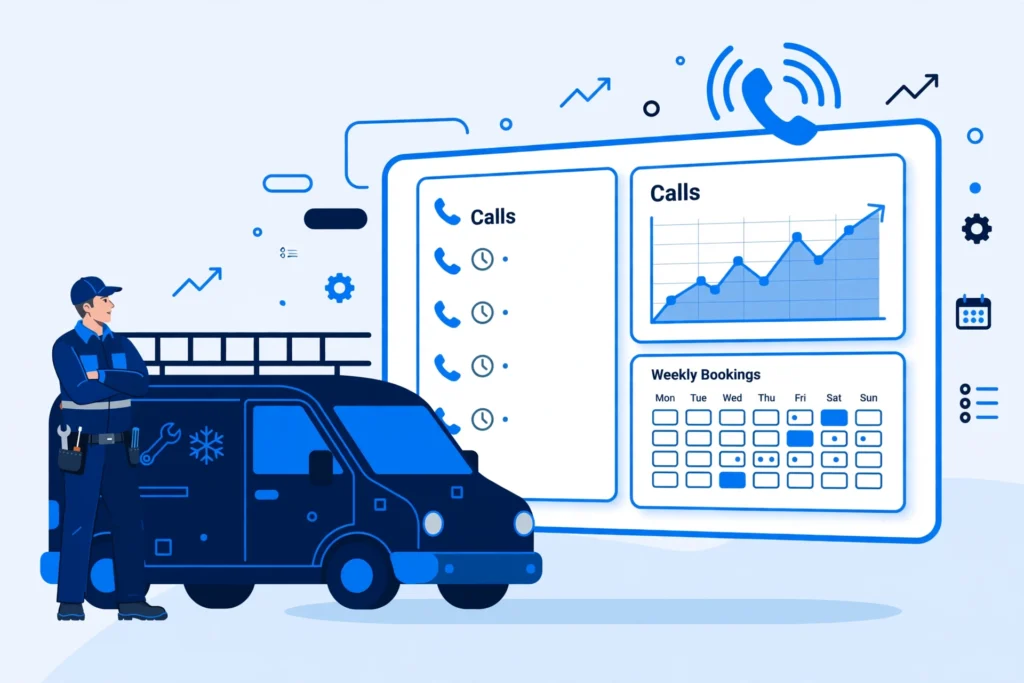
When the first 95-degree week lands, every tech is on a roof and the office phone rings out. Voicemails get returned the next day, by which time the homeowner has booked whoever answered. Replacement quotes — the big tickets — get decided over several days against two or three rival estimates, and the company with no follow-up loses a job it had already half-won. None of that is a ranking problem; it is why ranking work for HVAC has to include the plumbing of the phone itself: accurate hours and services on the profile, click-to-call that works, and call tracking that shows you how many Google calls you missed in the week it mattered most.
Maintenance agreements lapse quietly
The maintenance plan is the most valuable product an HVAC company sells — recurring visits, first claim on the replacement when the system finally dies — and it leaks silently. Plans lapse because renewal is a scheduling task nobody owns, and the homeowner drifts to whoever shows up on Google next spring. Search visibility is part of the defence: a company that owns the searches for “AC tune-up” and “furnace maintenance plan” in its area keeps re-winning its own customers, and picks up the neighbours whose plans lapsed somewhere else.
Reviews go stale between seasons
A profile whose newest review says “January, furnace fixed same day” reads very differently in July than one whose newest review is from two winters ago. BrightLocal’s 2026 Local Consumer Review Survey found 74% of consumers only trust reviews from the last three months. HVAC work is seasonal, so HVAC reviews arrive seasonally — unless a system asks for them after every completed job, in every month, which is a process fix rather than a marketing trick.
The expensive shortcuts keep getting more expensive
Google’s Local Services Ads and the lead platforms sell HVAC leads to you and your competitors simultaneously, and the per-lead price climbs every peak season because everyone bids in the same weeks. Owners describe the same frustration: paying more each summer for the privilege of racing three other companies to the same kitchen table. Rankings you own do not send you an invoice per call. (Our guide to checking whether an agency built you spammy backlinks covers the other shortcut that ends badly — the bought-link package.)
How do homeowners actually search for HVAC help?
In two completely different ways, and your website has to serve both:
- The breakdown search. Phone in hand, house at 91 degrees, typing “AC repair near me”. This searcher picks from the map pack in minutes, on three signals: who is open, who is close, who has recent good reviews. Your profile, your hours and your review freshness win or lose this one.
- The replacement search. Evening research over several days: “furnace replacement cost”, “how long does an AC unit last”, “heat pump vs furnace”. This searcher reads. Cost guides, honest lifespan content and a company that explains without overselling win a job worth ten service calls.
Most HVAC websites are built for neither: one services page that lists everything in a paragraph. Google ranks pages, and Whitespark’s 2026 Local Search Ranking Factors research (reported via BrightLocal) names the dedicated page per service as the top on-page pattern for local organic results. An “AC repair” page and an “AC installation” page are not duplication — they are two different customers.
What does HVAC SEO include?
- Google Business Profile, set like an HVAC company. “HVAC contractor” as the primary category — the single biggest map-pack factor in Whitespark’s 2026 research (profile signals, 32%) — with air conditioning repair, installation, furnace services and maintenance listed as services, seasonal hours kept honest, and photos of real installs.
- A page for each service line. AC repair, AC installation, furnace repair, heating installation, maintenance plans, and indoor-air or duct services where you offer them — each written around that job’s real searches, costs and questions.
- A maintenance-plan page that sells the plan properly. What a visit includes, why twice a year, what members get first in a peak week. This page is your shoulder-season engine: it catches tune-up searches in the quiet months and converts them into the recurring base that steadies the year.
- A review system tied to completed jobs. A short link, a text while the house is cooling down again, an ask that happens every time — so reviews arrive in February as reliably as in July.
- Call tracking that respects the seasons. Every Google call recorded, missed calls visible, so a peak week’s losses are a number you can fix rather than a feeling.
- Local links, earned. Suppliers, community teams, local coverage — the links that tell Google you are a company of this place. Links carry real weight in local organic results (24% in the same Whitespark research); bought ones carry real risk.
What does the map pack reward in an HVAC company?
Three things, in the order the research gives them: a profile whose category and services say HVAC clearly and completely; reviews that are numerous enough to clear the trust bar (BrightLocal’s 2026 survey: 47% of consumers rule out a business with fewer than 20 reviews) and fresh enough to prove you are trading now; and proximity — which you cannot move, but which service-area settings and service pages can legitimately widen. Notice what is not on the list: your advertising spend. The map pack is the one Google surface where a well-kept local company beats a bigger advertiser.
How we work with HVAC companies: the 90-day shape
Weeks 1–2: audit — profile, pages, reviews, listings, and a missed-call picture from your existing call data where it exists. Weeks 3–6: foundations — category, services, hours, listings cleanup, review system, tracking. Weeks 6–10: the service pages and the maintenance-plan page, written for your climate and your housing stock. Weeks 10–13: local links and the first report in calls. The work is deliberately front-loaded into whatever shoulder season you are in, so the build is finished before the weather does your marketing for your competitors.
Our way vs the cut-price way
| Question to ask | The cut-price way | Our way |
|---|---|---|
| What do you get? | A generic “home services” package, same for every trade | Work built around HVAC’s calendar: peaks, lulls, maintenance plans |
| What is written? | One services page, keyword-swapped | A page per service, written for breakdown searchers and replacement researchers separately |
| What happens in your off-season? | The retainer keeps billing; nothing changes | The off-season is when we build — so the peak finds you ready |
| Where do links come from? | Bulk directories and bought placements | Earned locally, or not built — with a free guide to check anyone’s links, including ours |
| What is reported? | Impressions and rankings | Calls: answered, missed, and what they were worth |
| What is promised? | Page one by summer, guaranteed | The work and honest seasonal timelines — nobody can guarantee a ranking, and Google’s own hiring guidance says so |
How much does HVAC SEO cost?
The same published prices as everything we sell: Starter $297/month (one location, a quieter market), Growth $597/month (several services, a contested market), Market Leader $997/month (multiple areas). No setup fee, month-to-month, cancel with 30 days’ notice. Full details: local SEO pricing.
Run the only maths that matters with your own numbers: if one system replacement is worth what it is worth in your market, how many extra replacements a month cover the plan? For most HVAC companies the answer is one — sometimes not even one — and every maintenance plan the visibility sells on top keeps paying twice a year.
How long until HVAC SEO works?
Profile fixes and a working review habit can move the map pack in four to eight weeks. Service pages need two to four months; a competitive metro, four to six. The HVAC-specific honesty: judge it across a season change, not across a fortnight. A company that builds in the shoulder season and measures at the peak sees the real number; anyone who promises you page one before the first heat wave is selling you a date, not a result.
Frequently asked questions
Should we pause SEO in the off-season to save money?
That is the most expensive saving in this trade. The lull is when pages get written, reviews get systematised and profiles get fixed — and the owners who go dark are the ones still quiet two months into the recovery, because a competitor stayed visible and took the returning demand.
Can SEO replace our maintenance-plan renewals problem?
Partly. SEO wins you the tune-up and maintenance searches that refill the plan base, and a proper maintenance page converts visitors your old site waved past. The renewal itself is an operations habit — reminders and scheduling — and we will tell you plainly where our work ends and that habit begins.
We are booked solid every summer. Why do we need this?
Because the summer book is weather, not a pipeline — and because the jobs you want more of (replacements, plan members) are decided in the researched searches, not the panic ones. Companies invest in the fat months to fix the lean ones.
Do you work with our existing website?
Usually, yes. Most HVAC sites need structure — pages per service, working click-to-call, the plan sold properly — more than a rebuild. The audit tells you which, with evidence, before you spend anything.
What do you need from us each month?
Almost nothing: access to the profile (manager access, in your name), photos of real jobs when you have them, and ten minutes on the monthly report call. The plan, the writing and the tracking are ours.
Is there a contract?
No. Month-to-month, 30 days’ notice, and the profile, pages, reviews and data stay yours if you leave.
Get the free HVAC SEO check
Run the free local SEO audit tool on your company, or ask for the full check before your next shoulder season: profile, pages, reviews and missed-call picture, measured against the HVAC companies currently winning your map pack.
Findings in plain language, yours either way.