Why Is My Local SEO Not Working?
Why is my local SEO not working? The cause is usually one of a few fixable problems: the wrong Google Business Profile category, too few recent reviews, weak service pages, messy business listings, or a website that gets visits but doesn’t turn them into calls. Find the real cause first, then fix that — not everything at once.
Below are the nine problems we find most often in audits, how to spot each one, and what to do.
Rather have someone check for you? Get a free local SEO audit — we’ll tell you which of these is holding you back.
1. Is My Google Business Profile Category Wrong?
A wrong primary category is one of the most common reasons a business doesn’t show in Google Maps for its main service. Google leans heavily on your primary category to decide which searches you’re relevant for, so it should describe the service that brings in most of your money.
Google explains how local results are ranked in its Business Profile help guide.
How to check: search your main service in your area and look at the top three Maps results. Note which category each one uses (shown under the business name).
Fix: set your primary category to match your main service. Add secondary categories only for services you actually offer.
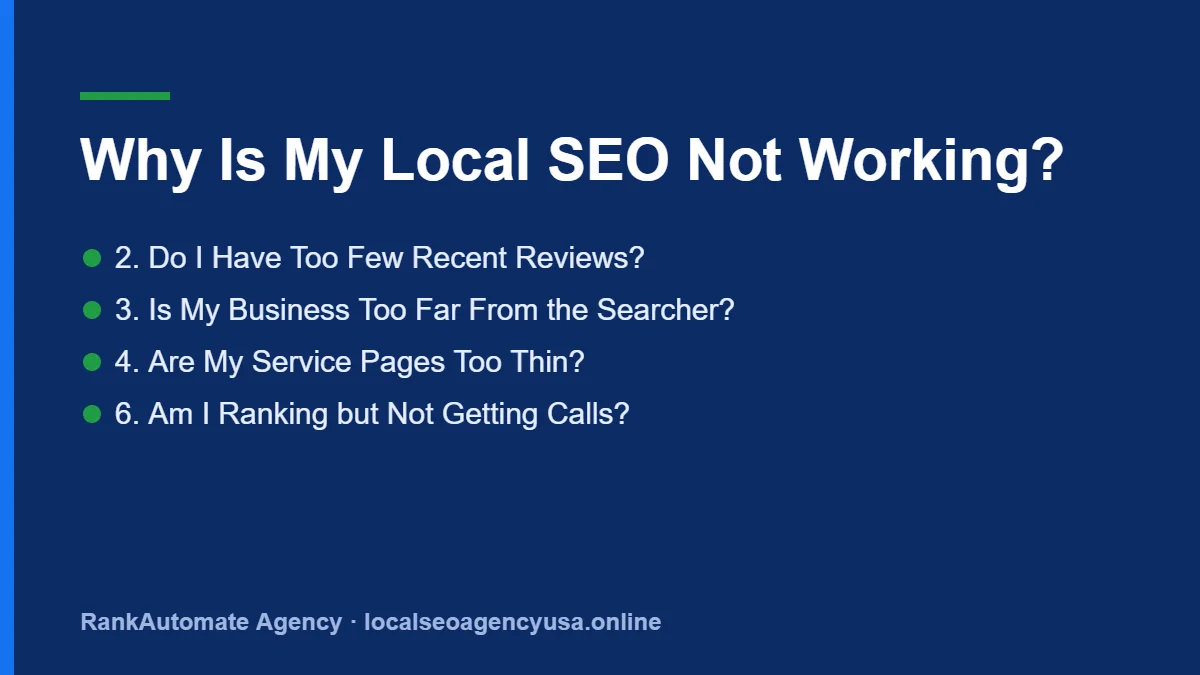
2. Do I Have Too Few Recent Reviews?
Too few reviews, or no new ones for months, makes it hard to beat competitors in the local pack. Reviews are part of what Google calls prominence, and customers compare review counts and star ratings before they call.
Fix: ask every happy customer within a day of the job, using a direct review link by text. Reply to every review. See our reputation management approach.
3. Is My Business Too Far From the Searcher?
Distance is one of Google’s three main local ranking factors, so you won’t rank in Maps for searches far from your business location — no matter how good your profile is. That’s normal, not a penalty.
Fix: for areas further away, build helpful website pages and earn local links and mentions there. Don’t create fake addresses — that can get your profile suspended.
4. Are My Service Pages Too Thin?
If your website has one page listing every service, Google has little to match against specific searches like “drain cleaning” or “AC installation.” Thin pages also don’t convince visitors to call.
Fix: build one strong page per main service with what you do, where, how it works, price guidance, reviews, FAQs, and a call button.
5. Are My Business Details Different Across the Web?
When your name, address, or phone number differ between Google, Yelp, Bing, Apple Maps, and directories, you confuse both customers and search engines. Old numbers and past addresses are common after a move or rebrand.
Fix: pick one exact format and update every listing to match. Our local citation services handle this cleanup.
6. Am I Ranking but Not Getting Calls?
If you rank but get no calls, the problem is conversion, not SEO. Visitors land on your page or profile and leave because they can’t find the phone number, don’t trust what they see, or aren’t sure you serve their area.
Fix:
- Put a click-to-call button and a short form at the top of every page.
- Show reviews and real job photos near the call button.
- Say clearly which towns you serve.
- Answer the phone — or call back within minutes. Missed calls are lost jobs.
How do I improve local SEO click-through rate? Write page titles that say the service, the town, and a reason to click (“Same-Day Drain Cleaning in Hempstead – Call Now”). On your Google Business Profile, add real photos, keep reviews fresh, and list services clearly — searchers click the listing that looks most trustworthy.
7. Am I Tracking the Wrong Things?
Many owners think local SEO isn’t working because they only look at rankings or traffic. What matters is calls, form leads, and booked jobs. Rankings can move daily; leads tell you if it’s paying off.
Fix: track phone calls (GBP call clicks plus call tracking on your site), form submissions, and how many became booked jobs. Compare month to month.
8. Is My Competition Just Stronger?
Sometimes local SEO is working, but your competitors have years of reviews, more links, and better pages. In that case progress is slower and comes from steady work, not quick fixes.
Fix: compare your profile and site side by side with the top three. Close the biggest gaps first. Our Google Maps SEO service starts with exactly this comparison.
9. Did I Give It Enough Time?
Local SEO usually takes three to six months to show steady ranking gains, longer in competitive cities. Profile fixes and reviews can help within weeks, but most businesses stop too early.
Fix: set a 90-day plan, measure calls monthly, and keep going if the trend is up.
Stop Wasting Time on Local SEO That Doesn’t Bring Calls
If you keep asking “why is my local SEO not working?”, guessing costs you more months. Our free audit checks all nine of these, compares you with your top competitors, and sends you a short video with the three fixes that matter most for your business.

“He explained every step in plain language, delivered what he promised, and always replied quickly.”
— Dr. Yousaf Tahir, Globale Green Consortium, New York
Prefer to fix it yourself? Download the free Local SEO Checklist.
Why Is My Local SEO Not Working? FAQs
Why did my Google Maps ranking suddenly drop?
Small daily movements are normal. Big drops are often caused by a profile edit Google didn’t like, a suspension, lost reviews, or a competitor improving. Check your profile for warnings first, then compare what changed.
Why am I #1 on Google but not in Maps?
Organic results and Maps use different signals. Maps depends heavily on your Google Business Profile, reviews, and distance, while organic results depend more on your website and links.
Should I switch SEO companies if my local SEO isn’t working?
First ask for proof of work done and a report showing calls and leads. If they can’t show either after three to six months, it’s reasonable to look elsewhere.

Written by Faisal Zahoor, founder of RankAutomate Agency (Semrush Academy certified in Local SEO). Read our editorial policy.