Google Finished One Core Update — and Already Announced the Next
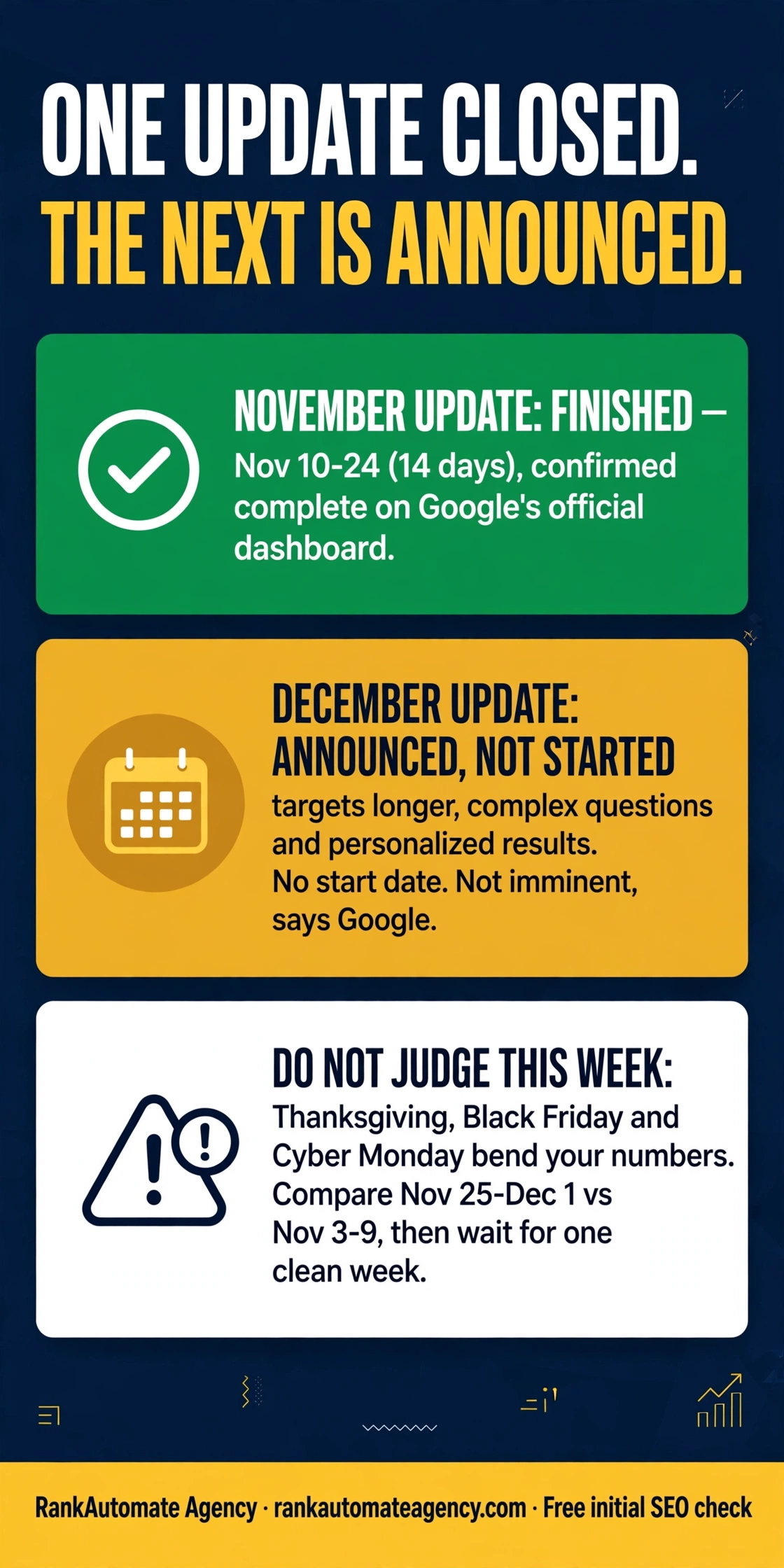
Google’s November update is finished, and the next one is already announced. Google’s Search Status Dashboard records that the November rollout was complete as of November 24, 2026, after 14 days. On that same morning, Google preannounced the December update, the first time it has ever announced one of these updates in advance.
If your rankings shifted this month, or your phone went quieter than usual, you are probably asking two questions: did the November update change anything for my business, and what is coming in December? We have gone through Google’s own dashboard entries and the confirmed reporting so you can separate fact from rumour. Here is what happened, what has not happened yet, and what we advise our own clients to do now.
| November 2026 update | December 2026 update | |
|---|---|---|
| Status | Finished | Announced, not started |
| Dates | November 10 to 24 (14 days) | No start date given |
| Confirmed by | Google Search Status Dashboard: complete November 24 | Google preannouncement, the first it has ever made |
| Focus | Broad re-sorting of search results; the third core update of 2026 | Longer, more complex questions and personalized results |
| What it means for your calls | Movement during Nov 10-24 has settled; judge it on a clean week, not holiday data | Nothing to fix yet; pages that answer full customer questions are the preparation |
Is the November update finished?
Yes, it is finished. Google’s Search Status Dashboard states that the rollout was complete as of November 24, 2026. The update began on November 10 and ran for 14 days, and Google counts it as the third update of this kind in 2026. The movement you saw during those two weeks has now settled.
For a local business, a rollout like this is the period when Google re-sorts who appears for the searches your customers make every day. If your calls dipped between November 10 and 24, it does not automatically mean your website got worse. It may mean a competitor’s pages were judged a better answer for a while. What matters is where you have landed now that the rollout is over, and whether your pages genuinely answer what your customers ask. That judgement, though, comes with a timing problem we will get to shortly.
What will the December core update focus on?
Google says it focuses on how its systems understand and rank relevant content, including for longer and more complex questions. Google also wants better personalized results for people who have personalization turned on. In plain words, Google is trying to give better answers when customers ask full, detailed questions instead of two or three keywords.
Think about how your customers actually search now. Many type or say a whole sentence: what they need, where they need it, and when they need it, all in one go. Pages that answer that complete question clearly, near the top, are the pages Google can understand and rank with confidence. Pages that only repeat a service name and a town give Google very little to work with. Google describes the update as “multiple improvements to how our systems understand and rank relevant content”, and that understanding is exactly what a well written service page feeds.
Why the early announcement? Google has also published a new ranking transparency hub in Search Central, which explains when it announces changes in advance. The advance notice is connected to the UK Competition and Markets Authority’s fair ranking rules. The hub points site owners to a feedback button in Search Console, and a UK indexing appeal is due to open on December 17. For most local businesses the hub changes nothing day to day, but it does mean this December announcement is official and on the record.
Has the December update started?
No, it has not started. A Google spokesperson confirmed to Search Engine Roundtable that the December update is not live and not active, and described it as not imminent. Google has given no start date and no expected rollout length. Anyone telling you it has already begun, or selling emergency fixes for it, is ahead of the facts.
The confusion is understandable. Google’s dashboard briefly flagged the December incident as active, which set off a round of alarming posts. The spokesperson then confirmed three times that it is not live. This matters for your wallet as much as your rankings: an update that has not started cannot have hurt your calls yet, and there is nothing to repair. Save your money and your worry for the day Google actually announces the start.
Why is this week the wrong week to judge your numbers?
Google’s standing guidance is to wait at least one full week after a rollout ends, then compare that week with a week from before the update. This time the week after, November 25 to December 1, holds Thanksgiving, Black Friday and Cyber Monday. Holiday demand and holiday closures will bend your traffic and your call numbers out of shape.
The comparison Google suggests is November 25 to December 1 against November 3 to 9. Run it if you like, but treat anything you see as unreliable. A quiet phone this week may simply mean your customers are travelling, shopping or closed for the holiday, not that your rankings fell. A busy week may be holiday demand, not an update win. The honest position is this: judge nothing final until the December update has also finished, and you have a normal week of calls and enquiries to measure against.
What should a business owner do now?
Here is the same short list we give our own clients when an update lands.
- Do not rebuild your website this week. Decisions made on holiday data are decisions made on bad data. A rushed rebuild can cost you the visibility and the calls you already have, and it cannot be undone when the real picture arrives.
- Write the dates in your diary. Mark November 10 to 24 as the rollout, and note the holiday week after it. When you review this quarter later, you will be able to separate update movement from holiday movement instead of guessing.
- Read your main service pages as a customer. The December update targets longer, more complex questions. Check that each key page answers the complete questions your customers ask, in plain words, near the top of the page, before the sales talk starts.
- Watch calls and enquiries, not just rankings. Positions move for many reasons, including personalization. Your call log and your enquiry forms are the numbers that pay your bills, so judge your visibility by them over the coming weeks.
- Wait for one clean week. Once a normal week has passed, compare it with a normal week from before November 10. If your calls are holding, your pages are doing their job. If they are not, that is the moment to act, with real evidence in hand.
The bottom line
One update has closed, and the next is already on the calendar, but the December core update has not started and nobody can honestly tell you today what it will do to your business. What you can control is whether your pages answer your customers’ real questions better than the business down the road.
If you would like to know where your business stands before December arrives, book a free initial SEO check with RankAutomate. We will review your visibility, your key pages and what is driving your calls, and tell you plainly what needs attention and what can safely wait.
Frequently asked questions
Where can I check the official status of a Google update?
Google’s Search Status Dashboard is the official record of when an update starts and when it finishes. Google has also published a new ranking transparency hub in Search Central that explains when it announces changes in advance, and there is a feedback button in Search Console if you believe an update has treated your site unfairly.
What do personalized results mean for my business?
It means two customers can search the same words and see slightly different results, because Google adjusts results for people who have personalization turned on. The position you see when you search your own business may not be what a customer sees. Judge your visibility by your calls and enquiries, not by a single search of your own.
I read that the December update is already live. Is that true?
No. Google’s dashboard briefly flagged the December incident as active, which started the rumour. A Google spokesperson then confirmed three times that the update is not live and not active, and Google says it is not imminent. Until Google announces a start, treat any claim that it has begun as unverified.